

Main Header Row
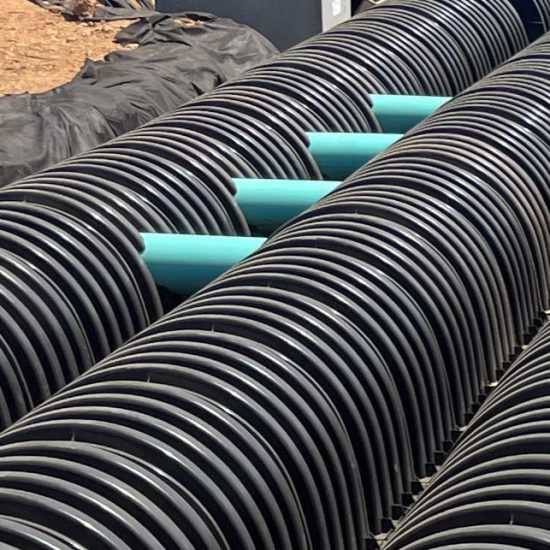
An innovative solution adds water quality to every storage and infiltration system
The Main Header Row is a water-quality component that captures pollutants with filtration in a designated section of a storage system. This innovative water-quality component isolates pollutants from the primary storage system and keeps pollutants from compromising the efficacy of the entire system.
Typically installed at each inlet, the Main Header Row allows treated stormwater to flow into the rest of the storage system without the need for a manifold, and eliminates the need to clean out individual storage rows.
The Main Header Row can be installed as a water-quality component with all chamber models, the Aquamod crates and the vaults.
Material
Fiberglass-reinforced plastic (FRP)
Approvals
NJCAT technology verified
Virginia DEQ approved
TSS Removal
85.1% cumulative total suspended solids (TSS) removal
Proven high-performance pollutant removal
Whether the main storage system is constructed of chambers, vaults or crates, the Main Header Row is NJCAT-verified for more than 85% removal of total suspended solids (verified to the 2021 NJCAT filter protocol). It is also verified for phosphorous removal up to 40%.
Designed and engineered for maximum flexibility
- Designed to reduce maintenance costs
- Engineered to maximize storage system life
Integrated internal bypass manifold simplifies installation
- Reduces footprint by removing the need for external piped manifold
- Can be ordered precut for faster installation
- Can be cut on-site for flexibility with pipe connections (up to 12 inches)
A Main Header Row can be made of any of these chamber models
|
Chamber Model
|
Max. Treatment Flow Rate gpm (L/s)
|
Drainage Area acre (m²)
|
|---|---|---|
|
S-29B
|
47.2 (3.0)
|
0.076 (308)
|
|
S-22
|
37.6 (2.4)
|
0.060 (243)
|
|
C-10
|
29.2 (1.8)
|
0.047 (190)
|
|
M-6
|
24.0 (1.5)
|
0.038 (154)
|
A simple way to increase the system’s treatment flow rate and filtration area is to expand the Main Header Row footprint.
Easy inspection and maintenance
After an initial inspection to verify the system is functioning as designed, the system should also be inspected immediately after the first major rainfall or storm event.
- Inspect the Main Header Row by accessing the inspection ports and adjacent structures to measure the depth of captured sediment
- If the depth of sediment has met the limit outlined in the Main Header Row O&M Manual, perform maintenance per those instructions
- Use an adjacent structure to access the Main Header Row with a high-pressure sprayer and vacuum
- Use the sprayer to flush the sediment and debris towards the vacuum
The schedule for ongoing inspection and maintenance is based on the following factors:
- Storage system size
- Site and environmental conditions
- Drainage area
- Annual rainfall
- Volume of stormwater runoff
- Volume of sediment, dirt, debris and trash
Note: For full instructions see the Main Header Row O&M Manual.